Nasdaq Extends Trading Hours - What It Really Means for Market Data Systems

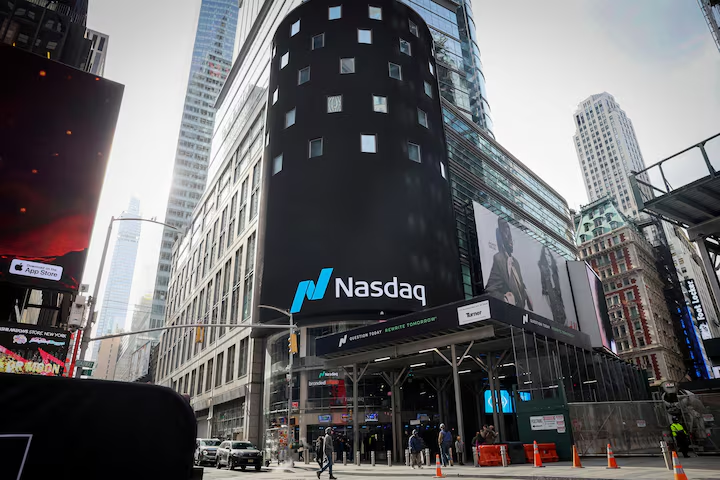
Yesterday (2025.12.16) Nasdaq announced an extension of its trading hours, a move that once again reshapes how modern markets operate. While headlines focus on increased accessibility and global participation, the real impact is felt much deeper in the technology stacks that power trading, analytics, and risk systems. Extending trading hours is not just a business or regulatory change. It’s a data engineering problem. And a non-trivial one. In this post, I want to unpack what extended trading hours actually mean from a technical perspective, why many traditional data architectures will struggle, and why systems built with KDB/Q (or KDB-X) are particularly well suited to absorb this change without breaking a sweat.
What Changed: More Time, More Data, Same Expectations
Historically, markets had well-defined trading sessions. Systems were designed around them:
- A clear start of day
- A clear end of day
- Overnight batch processes
- Predictable data volumes
- Fixed intraday windows for analytics
Extended trading hours fundamentally challenge these assumptions. From a systems perspective, this means:
- Longer continuous data streams
- Higher total daily data volume
- More intraday state to manage
- Fewer clean reset points
- Increased overlap across regions and venues
And crucially: Latency, throughput, and availability expectations do not relax just because the day is longer.
The Hidden Cost: Volume Isn’t Linear
A common mistake is to assume that extending trading hours simply increases volume linearly. In practice, it often doesn’t. Extended hours introduce:
- Higher market fragmentation
- More algorithmic and automated participation
- Increased event-driven bursts (news, macro, cross-venue reactions)
- Longer periods where real-time analytics must stay hot
That means more ticks, more state, more joins, more aggregations, and more pressure on memory and compute.
Systems that were “just about fast enough” during regular hours may suddenly fall over.
Why Many Databases Will Struggle
Most modern data stacks weren’t designed for continuous, high-frequency, time-series workloads.
1. Row Based Storage
Row-oriented systems are inefficient when queries scan time ranges across a small number of columns, which is exactly what market data workloads do.
2. Disk-First Architectures
Systems that rely heavily on disk I/O, even with caching, struggle when real-time queries and ingestion happen simultaneously over extended periods.
3. Complex Streaming Pipelines
Many stacks glue together:
- A streaming layer
- A storage layer
- A compute layer
- A query layer
Each boundary adds latency, failure modes, and operational complexity.
4. Overnight Assumptions
Batch jobs, rollovers, save-downs, and re-indexing jobs often assume a quiet overnight window. Extended trading hours shrink, or eliminate, that window entirely.
Why KDB Handles This Naturally
This is where KDB/Q stands apart, not because it’s “fast”, but because of how it’s designed.
1. Built for Continuous Time-Series
KDB/Q is not a database that supports time-series. It is a time-series system by design.
- Data is stored in vectors/arrays
- Time is a first-class concept
- Vector operations are second nature
- Queries scale with time ranges, not table size
Longer trading hours simply mean more rows. The access pattern doesn’t change.
2. In-Memory First, Disk as an Optimization
KDB/Q’s architecture cleanly separates:
- Real-time data (RDB), in memory
- Historical data (HDB), memory-mapped on disk
Extended trading hours don’t require redesigning the system. They just change how long the RDB stays hot and how often data is persisted.
Memory-mapped storage ensures:
- No deserialization overhead
- No ORM layers
- No impedance mismatch between memory and disk
3. Streaming Is Native, Not Bolted On
In KDB/Q, streaming isn’t an add-on, it’s the default.
- IPC is lightweight and event-driven
- Subscribers process updates as they arrive
- Backpressure patterns (e.g. chained tickerplants) are well understood
Whether the market trades for 6 hours or 20 hours is largely irrelevant. The system is already designed to run (almost) continuously.
4. Analytics Live Where the Data Lives
This becomes even more important with longer trading days. Instead of:
“Pull all the data out, then analyze it somewhere else”
KDB/Q allows:
“Run the analytics where the data already is”
That means:
- Smaller result sets over the network
- Lower bandwidth pressure
- Faster response times
- More predictable performance
Extended trading hours amplify the cost of moving data. KDB avoids that cost entirely.
Operational Reality: Fewer Moving Parts Win
When markets run longer, operational simplicity matters more than ever. KDB/Q based systems typically replace:
- Streaming frameworks
- Online Analytical Processing (OLAP) engines
- Time-series databases
- Analytics runtimes
... with ONE COHERENT SYSTEM
That matters when:
- Monitoring windows are longer
- Failure recovery must be faster
- Engineers are on-call for extended periods
- Systems must degrade gracefully, not catastrophically
This Is a Trend, Not a One-Off
Nasdaq extending trading hours isn’t an isolated event. Already towards the end of last year, we saw the New York Stock Exchange extend its trading hours (Read my blog post here). Most cryptocurrency exchanges already operate 24/7, and it’s clear that more traditional exchanges will follow this trend. We’re seeing:
- More global overlap
- More electronic liquidity
- More automation
- More demand for always-on systems
Markets are moving closer to continuous operation. Architectures that depend on:
- Quiet periods
- Batch windows
- Heavy ETL
- Complex pipelines ... will increasingly struggle to keep up.
Final Thoughts
Extended trading hours are a stress test for market data architectures. They expose:
- Hidden assumptions
- Scalability limits
- Operational fragility
Systems built with KDB/Q (KDB-X) don’t need to be reinvented for this shift. They were already designed for it. If anything, changes like this highlight why KDB/Q has remained dominant in high-performance market data systems for decades, not because it’s fashionable, but because it solves the right problems at the right level of abstraction. And as markets keep pushing toward longer, faster, and more continuous trading, those design choices matter more than ever.
If you need help designing or architecting your KDB/Q system, feel free to reach out! Happy to chat. Until then, happy coding.
Reference: Reuters: Nasdaq seeks to extend trading hours, as Wall Street gears up for 24/7 move